Case Study: The Semiconductor Industry
The cost of building a typical fabrication plant has increased by over 5,000% in the last 30 years. Today, a truly state-of-the-art fab, such as Taiwan Semiconductor Manufacturing Corporation’s (TSMC) “Gigafab”, costs nearly $10 billion. Given a liberal operating lifetime of 10 years, the fab will need to produce nearly $20 million of gross margin output every week of its life just to cover depreciation costs. Investments such as these have led to significant consolidation in the industry and even for the select few industry ‘players’ still competing there are significant barriers to generating unique processes or competitive innovations. |
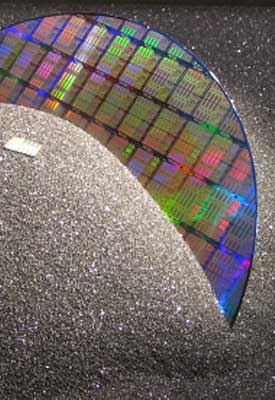
About Semiconductor ManufacturingSemiconductor device fabrication is the process used to manufacture the integrated circuits present in electrical and electronic devices. It is a multiple-step sequence of photolithographic and chemical processing during which electronic circuits are formed upon highly polished wafers made of pure semiconducting material (silicon) about 0.75 mm thick. The process is performed in highly specialized fabrication facilities referred to as fabricators, or ‘fabs’. Typically, the final product’s entire manufacturing process, from start to packaged chips ready for shipment, encompasses several months. Although the birth of semiconductors can be traced to a much earlier date, it’s widely accepted that the integrated circuit industry emerged around 1960, once design and fabrication of complex semiconductor devices became a viable business. Fifty years later, design and fabrication of semiconductor devices has grown to approximately $250 billion worldwide. The industry enables the generation of some $1.2 trillion in electronic systems business and $5 trillion in services, representing close to 10% of the world’s GDP. 1 |

 |
 |
 Innovations in the semiconductor